

SUPPORT
Welcome to DY Chain Support Center. Find everything you need to select, install, maintain, and troubleshoot your motorcycle chain. Whether you're a dealer, mechanic, or rider, our comprehensive guides help you get the most out of your DY chain.
Chain Selection Guide
How to select the chain specification based on the engine displacement of a motorcycle?
|
Motorcycle displacement |
Recommended chain specifications |
Motorcycle type |
|
50cc – 125cc |
420, 428 |
Scooters, off-road vehicles |
|
125cc – 250cc |
428, 520 |
Trams, commuter motorcycles |
|
250cc – 600cc |
520, 525 |
Medium-displacement sports motorcycles |
|
600cc – 1000cc+ |
530 |
Large-displacement, high-torque motorcycles |
How to choose the type of chain?
|
Chain type |
Applicable scenarios |
Maintenance frequency |
|
Non O-Ring Chain |
Off-road, mud-terrain racing, scenarios emphasizing lightweight design |
Lubrication every 300 - 600 kilometers |
|
O-Ring Chain |
Trams, commuting, daily cycling |
Lubrication every 600 - 1000 kilometers |
|
Silent/Timing Chain |
Engine timing system, oil pump drive mechanism |
Regular inspection, replace every 30,000 - 50,000 kilometers |
Contact us for product selection assistance.
Chain Size Chart
Drive Chain
|
Chain specification |
Pitch |
Inner Width |
Roller Dia. |
Applicable scenarios |
|
420 |
1/2″ (12.70mm) |
1/4″ (6.35mm) |
7.75mm |
Lightweight off-road, 50 - 125cc |
|
428 |
1/2″ (12.70mm) |
5/16″ (7.94mm) |
8.51mm |
125 - 250cc street bike |
|
520 |
5/8″ (15.88mm) |
1/4″ (6.35mm) |
10.16mm |
250 - 600cc sports motorcycles |
|
530 |
5/8″ (15.88mm) |
3/8″ (9.53mm) |
10.16mm |
600cc+ Large-displacement motorcycle |
Timing Chain / Silent Chain
|
Chain NO. |
Pitch |
Inner Width |
Pin Dia. |
Average tensile load |
Applicable Instructions |
|
25 |
6.35mm |
3.10mm |
2.31mm |
4.30KN |
Standard timing chain |
|
25H |
6.35mm |
3.10mm |
2.31mm |
5.60KN |
Enhanced timing chain |
|
25N |
6.35mm |
3.10mm |
2.31mm |
5.60KN |
Enhanced timing chain |
|
CL04-5 |
6.35mm |
3.15mm |
2.50mm |
5.50KN |
Silent timing chain |
|
CL04-7 |
6.35mm |
5.20mm |
2.50mm |
8.20KN |
Wide-body silent chain |
|
CL04-9 |
6.35mm |
7.20mm |
2.50mm |
10.50KN |
Wide-body silent chain |
Additional Explanation:
Pitch: The distance between the pins of the chain, which determines the compatibility between the chain and the sprocket.
Inner Width: The width of the chain on the inner side, which determines the strength of the chain and the applicable torque.
Chain Type Guide
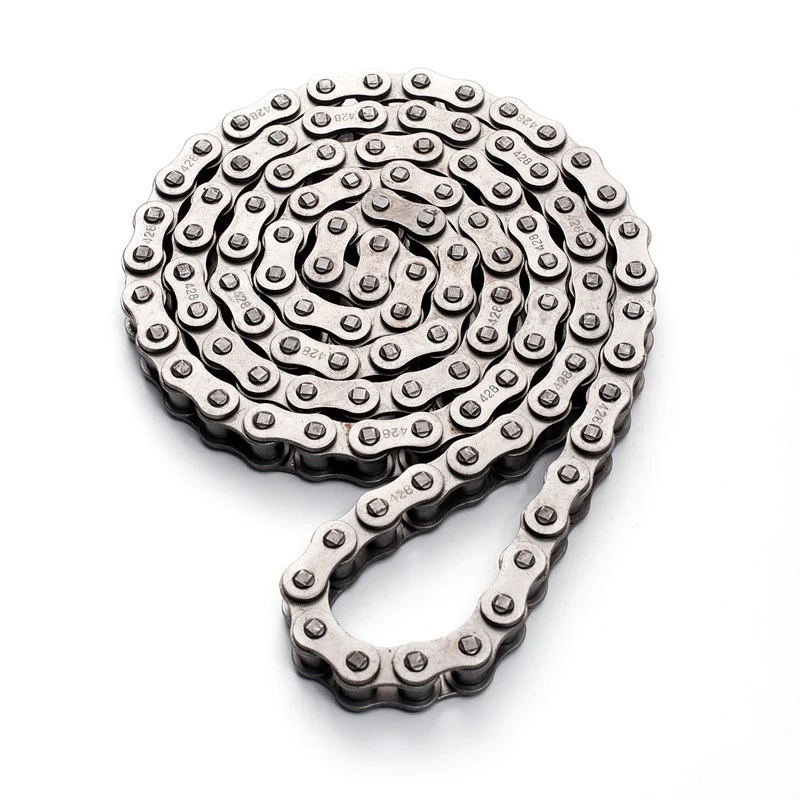
Non O-Ring Chain (Non-sealing Ring Chain)
Features: Simple structure, light weight, affordable price
Advantages: Intuitive maintenance, low cost, suitable for muddy environments (less likely to get stuck by mud and sand)
Disadvantages: Requires more frequent lubrication and cleaning
Recommended product: 428H Gold Drive Chain (Suggested replacement every 3,000 miles)
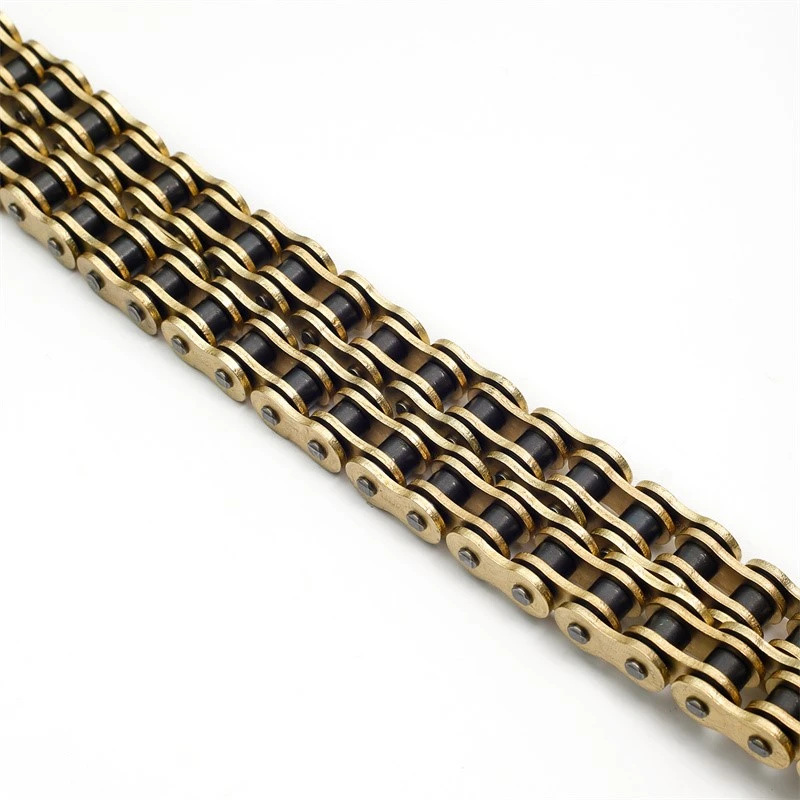
O-Ring / X-Ring Chain (Sealing Ring Chain)
Features: Contains O-type or X-type sealing rings between the pin shaft and the rollers
Advantages: Sealing grease does not leak easily, longer lifespan, longer maintenance interval
Disadvantages: Slightly heavier, higher price
Applicable scenarios: Street bikes, commuting, long-distance cycling
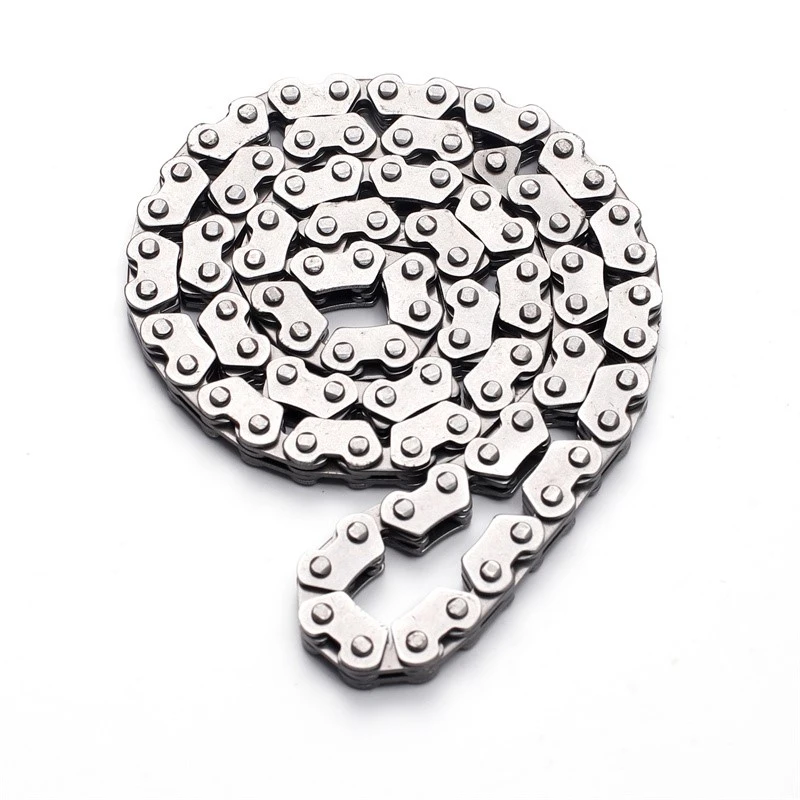
Silent Chain / Timing Chain
Features: Toothed chain structure, extremely low operating noise
Advantages: 5-8 decibels quieter than traditional roller chains, high precision, long lifespan
Applicable scenarios: Engine timing system, oil pump drive, balance shaft drive
Installation Guide
Preparation
Confirm that the new chain specification matches the original vehicle (refer to the size comparison table above)
Prepare tools: chain cutter, grinding wheel machine, torque wrench, caliper
Remove the old chain
Before using the chain cutter, first grind off the part where the pins are riveted with a grinding wheel machine
Remove the old chain and the front and rear sprockets (it is recommended to replace both the sprocket and the chain at the same time)
Install the new chain
Pass the new chain through the front and rear sprockets, ensuring alignment
Use spring-type joint link or riveted joint for connection
Note: The riveted joint is the recommended connection method by brands such as RK
Adjust the chain tension
The ideal tension is approximately 2%-3% of slack
Check the free travel of the chain at the tightest point
Final inspection
Confirm that the sprocket and the chain are in the same plane (alignment)
Manually rotate the rear wheel and check for any sticking or abnormal noise
Maintenance Guide
Lubrication
|
Maintenance project |
Frequency |
Explanation |
|
Chain lubrication |
Every 300 - 600 kilometers (200 - 400 miles) |
Off-road / harsh environments should be visited more frequently |
|
Chain tightness check |
Check approximately 500 kilometers (300 miles) after the first installation |
Check every 1000 kilometers thereafter |
|
Chain cleaning |
Every 1,000 kilometers or as the situation may require |
Use the dedicated chain cleaner |
Lubrication steps:
- Ride for a short distance to preheat the chain (warm up).
- Use a special chain cleaner to clean the chain.
- After it dries, apply the chain lubricant or chain oil evenly.
- Allow the lubricant to penetrate for a few minutes, then wipe off the excess portion.
Chain Inspection
- Wear Inspection: Measure the degree of chain stretching (Replacement is required if stretching exceeds 2%-3%).
- Roller Inspection: Check if the rollers rotate smoothly and if there is any abnormal wear.
- Sealing Ring Inspection (O-Ring/X-Ring): Check if the sealing rings are intact and if there are any cracks.
- Sprockets Inspection: Check if the sprockets teeth have worn into a hooked shape (Replacement is required simultaneously).
Replacement cycle
- Non O-Ring Chain: It is recommended to inspect every 3,000 miles (approximately 5,000 kilometers) and replace it if worn.
- O-Ring/X-Ring Chain: It is recommended to replace every 20,000 miles (approximately 32,000 kilometers).
- Always replace both the front and rear sprockets simultaneously.
FAQ
Q1: Are you a manufacturer or trading company?
We are a professional motorcycle chain manufacturer with over 20 years of experience.
Q2: Can you do OEM/ODM for us?
Yes, we offer full OEM and ODM services including custom colors, custom packaging, and private labeling.
Q3: What certifications do you hold?
We hold ISO9001 and other quality certifications.
Q4: What is your MOQ?
Our MOQ is 500 pcs. Sample orders are also welcome.
Q5: Can I get a sample?
Yes, samples are available.
Q6: What is your warranty period?
12-month after-sales service
Q7: How do I choose the right chain for my motorcycle?
Please refer to our Chain Selection Guide and Size Chart above. Of course, you can also directly contact us.
Q8: How often should I lubricate my chain?
Every 300-600 km (200-400 miles) for non-sealed chains, and every 600-1000 km for sealed chains.
Q9: Do I need to replace sprockets when changing the chain?
Yes, we strongly recommend replacing both sprockets when installing a new chain to ensure proper fit and longevity.
Q10: What is the difference between O-Ring and Non O-Ring chain?
O-Ring chains have built-in seals that retain lubrication longer, while Non O-Ring chains are lighter and suitable for off-road conditions.
Download
Huzhou Dongyao Chain Industry Co., Ltd.